
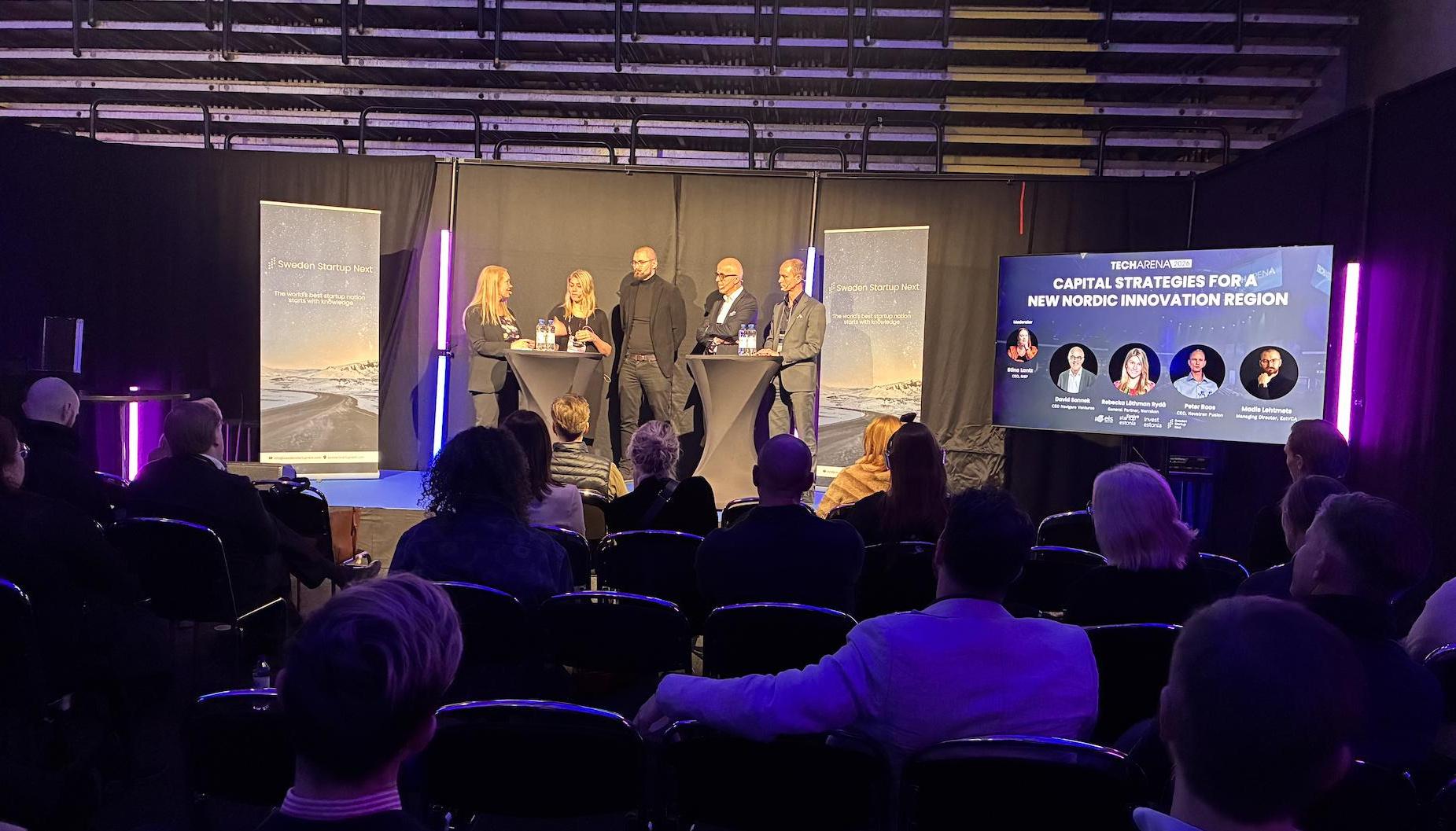
At TechArena, Scandinavia’s largest tech and business event, startup ecosystem experts outlined three priorities for strengthening Baltic and Nordic competitiveness. They warned that without access to large-scale growth and infrastructure capital, the Nordics risks becoming the R&D department of the United States and China.
Kati Pärn, Head of Nordic Partnerships at Startup Estonia, said the New Nordics is emerging as one of Europe’s most dynamic innovation regions, but that growth companies still need better access to capital. “Our region is producing breakthrough research and has given rise to many successful, ambitious founders and startups. Yet scaling internationally remains difficult, because bringing innovation to market requires significant capital and the ability to take that innovation to global markets and industrial scale depends on it,” Pärn explained.
In a discussion on the opportunities and bottlenecks across the Baltics and Nordics, panellists noted that technology companies founded six to ten years ago have now entered the growth stage. To scale further, they need more private and institutional capital and capital structures designed for scale. Experts cautioned that without access to large-scale growth and infrastructure capital, Europe risks becoming the R&D department of the US and China, not the home of the next industrial platforms.
One of the panel’s key takeaways was that political courage equal to the region’s ambition could become a major competitive advantage for the New Nordics. To make that happen, governments would need to be willing to take greater investment risk and to act as first customers and market makers for innovation.
Experts also said pension funds could play a much larger role in the future by helping unlock institutional capital for venture and growth investment. At the same time, they acknowledged that financing deep tech startups with long development cycles requires more patient, risk-tolerant capital and greater flexibility.
Madis Lehtmets, CEO of the Estonian Private Equity and Venture Capital Association (EstVCA), said pension funds have historically been one of the most important sources of local capital for technology companies’ growth, but that regulatory restrictions in recent years have reduced their capacity to invest in innovation. “If we want Baltic and Nordic companies to grow into global industries, we need more flexible capital structures that allow institutional capital to participate in deep tech investments with long development cycles,” Lehtmets stressed.
Three priorities
Experts agreed that if the New Nordics is to develop into a unified capital region, one that attracts global investors and can support the next generation of scaleups, three priorities stand out.
First, panel noted that despite geographical proximity, Baltic and Nordic ecosystems remain too fragmented. The panel called for stronger cross-border LP–GP dialogue, joint investment initiatives and deeper founder collaboration. Experts also emphasised that regulations, support measures, financing instruments, and ecosystem activities need to be designed in a coherent, joined-up way to increase countries’ risk appetite and to improve startups’ chances of success.
Second, panellists highlighted the need for a New Nordic fund-of-funds structure designed to allow pension funds allocate meaningful capital without building large internal teams, such a vehicle could also crowd in international investors seeking sizeable entry points into the region.
Third, they argued that governments must be ready to take greater investment risk in strategic sectors such as energy, defence, and green and climate technologies. One solution raised was state-led innovation procurement, with the state acting as a first customer and helping new technologies reach the market faster.
The panel discussion, “How do we build a globally competitive New Nordics capital region?” featured David Sonnek, CEO of Navigare Ventures and former CEO of Industrifonden;Rebecka Löthman Rydå, General Partner at Norrsken Evolve; Madis Lehtmets, Managing Director of EstVCA; and Peter Roos, CEO of Novatron Fusion. The discussion was moderated by Stina Lantz, CEO of SISP and Steering Committee member of Sweden Startup Nation/Next.